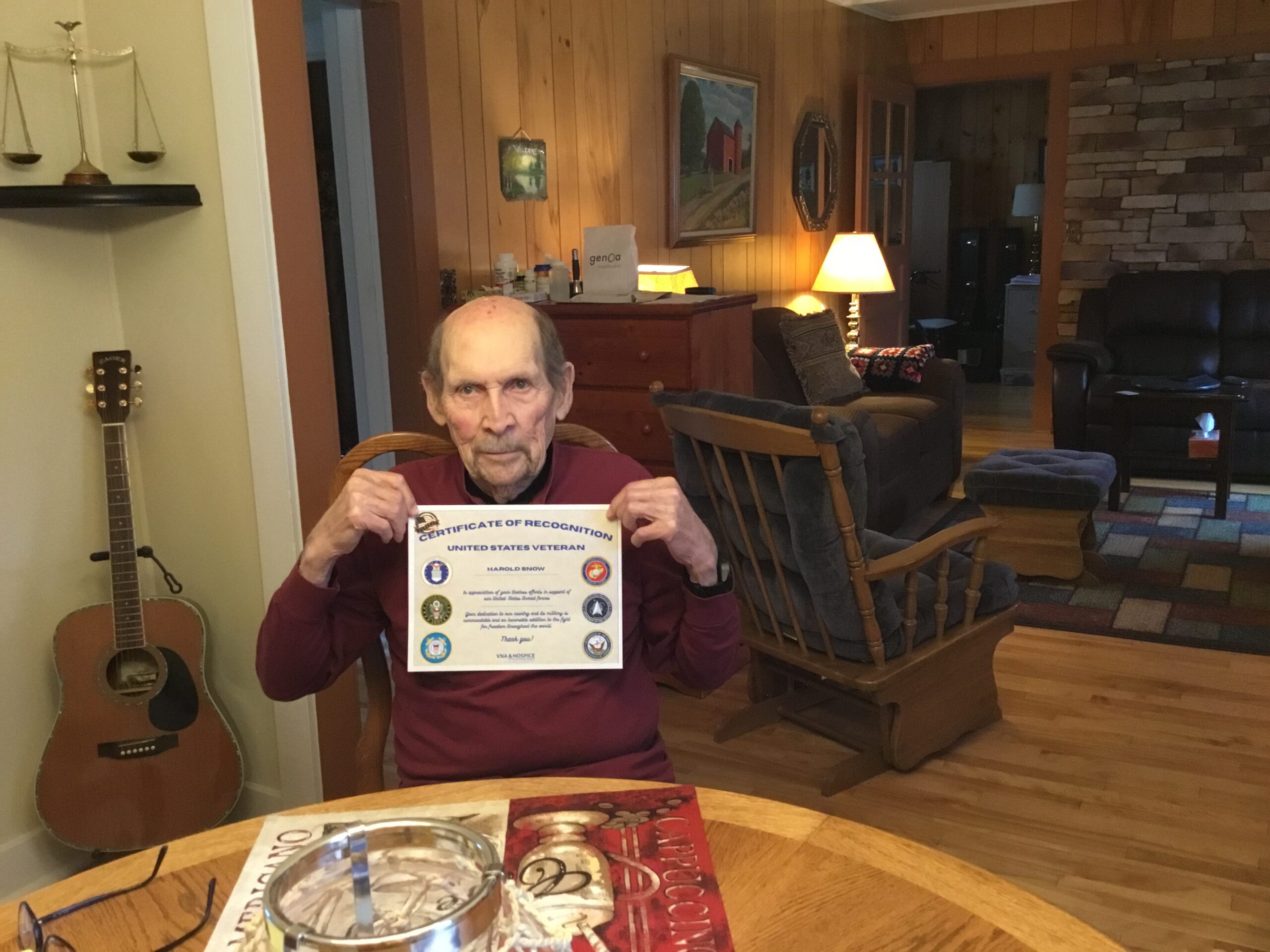
Harold Snow tells us that his time serving in the Navy was just one of the many roads he has traveled during his 93 years of life.
Harold Snow is a man of many talents. He was able to share with us a lifetime of varied experiences fueled by his curiosity for learning and interest in exploring new ideas.
He remembers that even as a young boy, he was interested in experimenting with new ideas and bringing them into creation. A prominent memory for him was the time he set out to build his own model of a small mechanical car from parts he found at the dump. At that time, in the 1940s, his mother had received her first machine operated washing machine. A neighbor, who Harold will always be grateful for, recognized his thirst for knowledge and ingenuity. He taught him how to calculate horsepower and apply mechanical principles when building things and using different parts to power them. We can only imagine what his mother was thinking when attempting to start her new washing machine!
All through his childhood, Harold continued to have a natural ability for absorbing information without necessarily learning from formal education. By the sixth grade, he dropped out of school as they were teaching things he had already learned by himself or by hands on from others.
By the age of 18, he had already worked for or had been self-employed in the area of auto repair. At that time, he was curious about what he could learn in the service and his parents encouraged him to consider enlisting in the armed forces. He got married before enlisting in the Navy and served during the Korean War from May of 1951 to May of 1955.
He spent part of his first year in a naval base in Norfolk Virginia undergoing basic training. Norfolk was and continues to remain one of the largest naval bases in the world and was home to the US Fleet Forces Command. Following basic training, he was given a choice to be deployed to South America or go on to receive specialized training to be a naval mechanic. In hindsight he wonders if it may have been more exciting to have chosen the South America deployment, but he didn’t want to miss the opportunity to develop more mechanical skills. Ironically, when he was then deployed during his final 3 years to serve on a naval cruiser in the Mediterranean, he was not assigned to use his mechanical skills.
Though Harold minimizes his role as not using his mechanical skills, instead he was assigned to a highly critical watch stander role of a throttleman. These individuals worked in 4 hour shifts manning 1 of 4 massive propellers. Throttlemen played a crucial role in assisting in controlling the ship’s speed and direction by adjusting the flow of high pressure steam to the main propulsion turbines. Harold humbly did not think think that this was a big deal. Though at that time the engine room was notoriously loud and hot and during high speed maneuvers throttleman had to respond to orders from the bridge and manage the flow of stream and oil pressure to prevent stalling the turbines or damaging the gears. It is no wonder that an individual with Howard’s intelligence and desire to succeed would be chosen for this role.
Another thing that Harold remembers about his deployment was target practice. Maneuvers involved firing naval artillery at radio controlled 6-8 foot unmanned small aircraft which were the precursors to modern day drones.
During his final days of active service, Harold was transferred from a naval cruiser to a battleship before traveling back to the US for his final departure in Virginia.
Following his naval service, Harold did use his GI bill to attend night school for welding. Over the years he went on to run a number of businesses, some of which involved auto repair, welding and heat treating of metals. His additional avocational pursuits involved woodworking, furniture construction, stonework and fostering a love for music and playing the guitar. His favorite memories involve traveling the country on a motorcycle with his late wife visiting every state except Washington and Oregon and logging up to 300,000 miles.
As we concluded our pinning ceremony and interview with Harold Snow, we felt warmed by his ready smile and we were grateful to have been in the presence of a true Renaissance man.